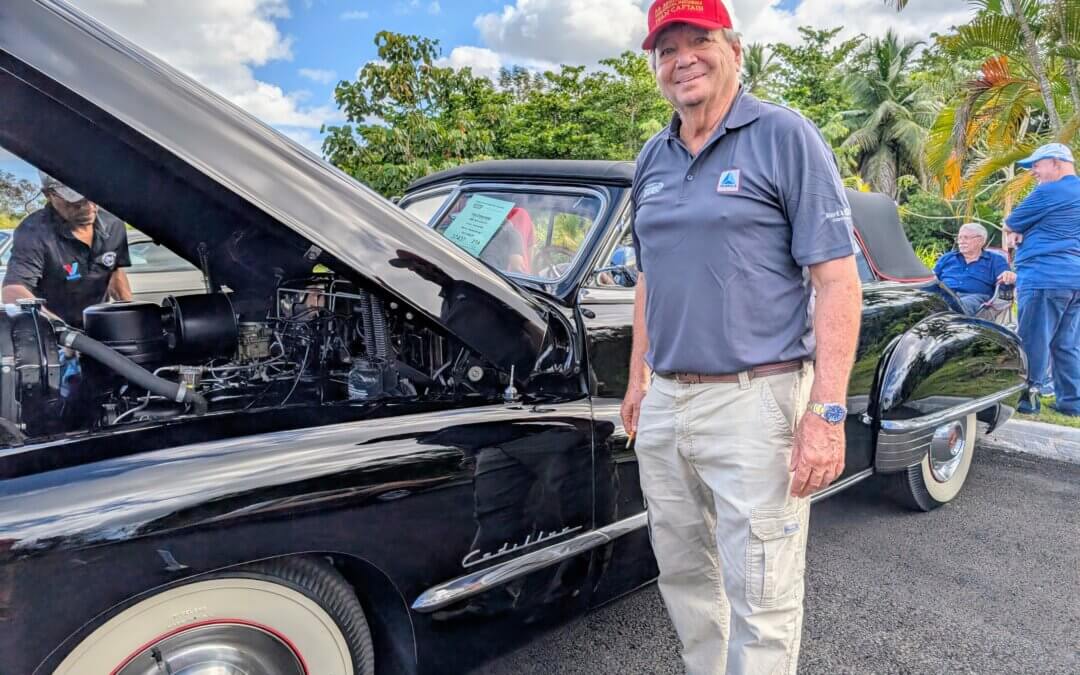
I recently learned that Puerto Rico has many ethnic influences, resources, and political limitations. It began as a territory of the United States in 1898 following the Spanish-American War, and became a commonwealth in 1952. I stayed there in March 2026, to judge an antique automobile show, and learned that this territory has many assets that improve by partnering with our 50 states. Determining the extent of that partnership and those improvements presents a tension there and within the 50 states.
The Antique Automobile Club of America includes the Puerto Rico Region. Its members participate in AACA events such as the antique and classic car show hosted by the Hershey Region which occurs in Pennsylvania each October. There, in 2025, I met Melvin Ramos Biaggi, who served on a judging team that I captained. Melvin persuaded me to judge at the AACA show in Puerto Rico for which he served as chair. His charisma piqued my interest in visiting Puerto Rico, a desire that I developed in college when a Puerto Rican classmate spoke about her wonderful island. It was important that my questions about this island be answered!
My wife, Florita, and I booked our stay in a hotel in Miramar, PR, owned by a member of the Region. The hospitality there (discounted rooms, premium location in San Juan Metro, and staff kindness) hinted at the reception we mainland AACA members would enjoy all week. Among our ranks were AACA judges, team captains, judging administrators, and staff. Florita and I arrived days before the car show so we could enjoy a vacation, not just serve as a judge.
That first day we walked throughout the Miramar area, a portion of San Juan Metro. Families swam in the Condado Lagoon whose light blue water contrasted with the concrete highways that encircle this marine habitat. Our hotel was situated on Ponce de Leon Avenue, which runs 7 miles west to Old San Juan. Juan Ponce de Leon, founded this city in 1508, while serving the King of Spain. The next year, 1509, as Governor of Puerto Rico, he colonized the island. He first came to the New World on the second voyage of Christopher Columbus who discovered the island in 1493.
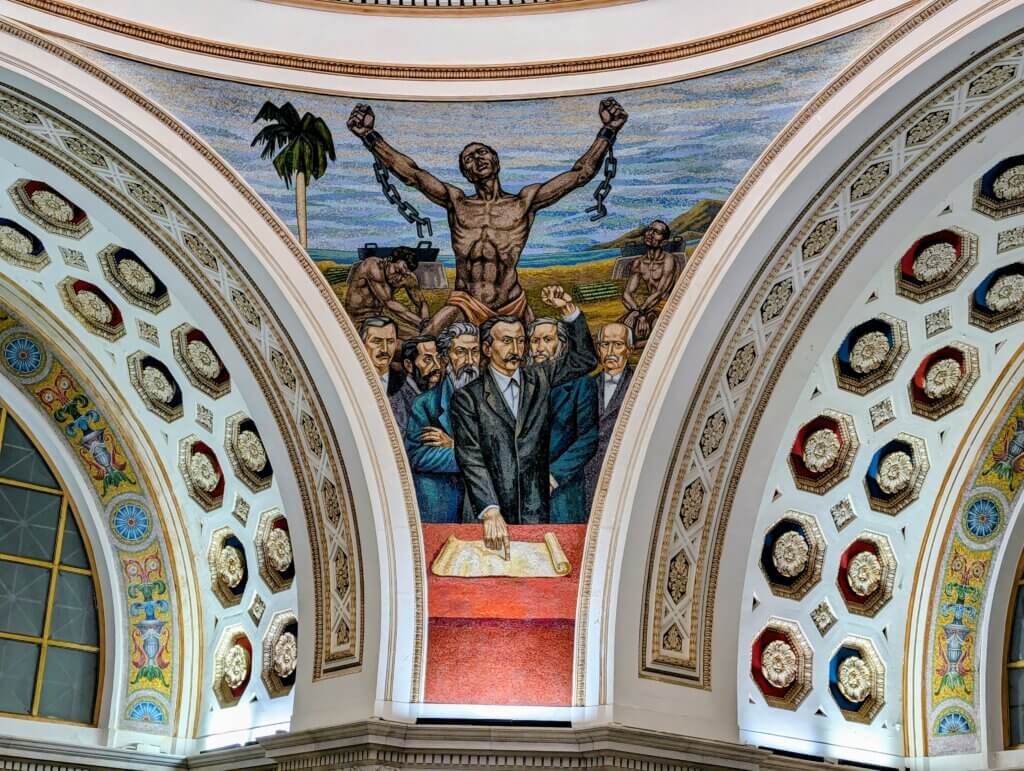
Those Spaniards discovered natives known as the Taino people, characterized by their kindness, village settlements, and agricultural, fishing, and craft vocations. Ponce de Leon subjugated the Taino to serve the King of Spain and his own interests. Today, Puerto Ricans have genetic influences of the Taino, the Spanish, Africans, and the United States. As Taino natives died from abuse by the Spanish and disease, Africans joined as slaves from 1513 to mine gold, build fortifications, and work in the sugar industry. Puerto Rico abolished slavery on March 22, 1873, now known as Emancipation Day, memorialized by a mural in the Capitol building.
On our second day, we rented a car and drove east to Loquillo. There, a public beach drew us to the pale blue water of the Atlantic Ocean. We enjoyed swimming, turtles, fish, birds, tacos, and Caribbean beverages. We walked east on the beach to leave the crowds of tourists and Puerto Ricans and to find solitude and serenity. Following a souvenir stop at the kiosks, we dined at La Fonda Gourmet, later learning that many of our friends and family enjoy its cuisine.
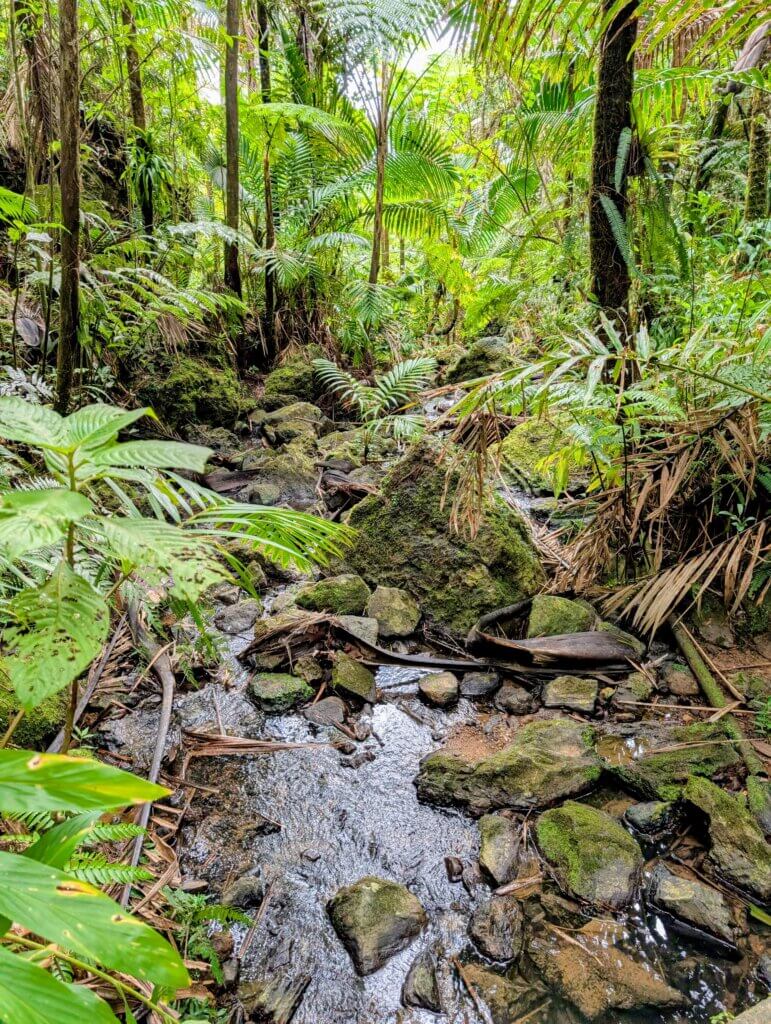
On the third day, we pushed further east from San Juan. We hiked the Mount Britton trail through El Yunque Rainforest, part of the American Forest system, to the top of Mount Britton. President Theodore Roosevelt proclaimed it the Loquillo Forest Reserve and brought it under the control of the U.S. Bureau of Forestry. The trail consists principally of an elevated concrete slab two feet above the ground, two feet wide, with large stones embedded in the mortar. These trails, the Mount Britton tower, and much of the infrastructure was constructed in the 1930s through the Civilian Conservation Corps. Fellow hikers wrongly assumed that it was built during Spanish rule, whose governors timbered the lower rainforest for agriculture.
Wet from the downpours in the rainforest, Florita and I headed to the sunny beach. That second shore visit was at Fajardo, known as the Seven Seas Beach. Here we enjoyed margaritas with local sunworshippers. Then we walked further east and found a serene coastline with a family from Wyoming and a Puerto Rican fisherman. The turquoise water is protected by a reef. We watched needle fish, turtles, and white-tailed tropicbirds.
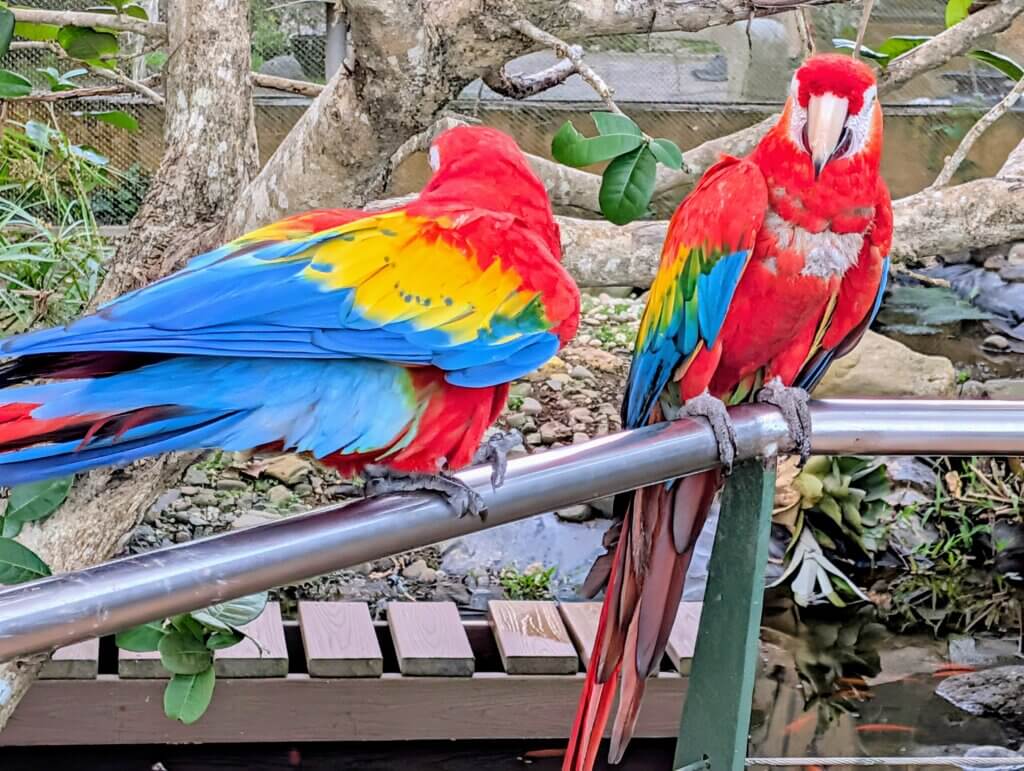
That night, the Puerto Rico Region took all visiting AACA members to La Marquesa Forest Park in Guaynabo near to where the show would be held. There, we took a gondola ride from the parking lot to a mountain where we found an aviary, butterfly garden, vistas and a large dining building. The colorful macaws flew around us within a netted expanse. We could see San Juan from the building located at 1,066 feet above sea level. This visit with a dinner was a second example of our hosts’ generosity, much like the kindness of Puerto Ricans who joined us at the rainforest and on the beaches.
We immersed ourselves in AACA culture on our fourth day. We bussed to Guaynabo for judging classes in the afternoon. I took a course on the AACA judging taught by AACA directors and the 1966 Pontiac GTO taught by our friend, Melvin Ramos Biaggi. A former Jaguar dealer, Jaime Del Valle, showed his 1955 BMW Leblond Speciale, combining Bugatti parts with a BMW engine and a Ferrari-like tubular frame. We began to realize that members of the Puerto Rico Region had exceptional motor vehicles, but to have a successful AACA show, they had to import judges and staff from the mainland.
That evening we visited the Capitol Building of Puerto Rico. Here we learned much of the history and political issues of the island. The people and historical highlights appear in statuary and murals on the walls – kind people overpowered by Spaniards and now developing mutual benefits with the U.S.A. Those murals include ceramic tile pieces embedded in the dome and central arches of the building. Our hosts have exceptional economic resources, sufficient to rent a dining area next to the Senate chambers, to provide an excellent meal, and to have elected officials welcome us. We celebrated Pedro Campos who founded the Puerto Rico Region of AACA.
Unseen in the Capitol is the Territories Clause of the U.S. Constitution, which grants Congress the plenary power to regulate Puerto Rico: to govern territories directly or delegate legislative power over them. Political positions in Puerto Rico regarding that relationship include independence (Puerto Rico Independence Party), strengthen territory status (Popular Democratic Party), and statehood (New Progressive Party). During the November 3, 2020 election, 52.53% voted for statehood with turnout at 54.72%. Under the Territories Clause of the U. S. Constitution, Congress may allow it to become independent, and under the Admissions Clause, Congress determines whether Puerto Rico may be a state.
We worked the fifth day as judges and administrators of the antique automobile show. I also served as a Team Captain with three other judges having complementary skills: Assistant Captain Jaime Velez, a local Puerto Rican with significant interpersonal and motor vehicle knowledge; Bill Bass, an architect with backgrounds in cars and airplanes; and Glenn Bailey, an apprentice who fostered children with his wife. We judged for two hours in the hot sun at the Escuela de Bellas Artes where 146 antique cars, trucks, and motorcycles were displayed.
One friend asked whether the show would look like the colorful cars in Havana, Cuba. Those 1950s cars exist through the skills of inventive people with few resources. However, antiques vehicles in Guaynabo were maintained with authenticity and great condition. They represented eras from pioneer cars such as the Ford Model T, beautiful 1940s Cadillacs, muscle cars of the 1950s and 1960, up to sports and European cars as new as 2002 models. The Puerto Ricans have wealth, access to new “old stock” parts, and skilled fabricators and painters. We finished the day at an awards banquet held in the Yolando Guerro Cultural Center. Our hosts showed tremendous generosity and truly enjoyed their complete AACA experience.
On the sixth day it rained so we visited art museums. There, we observed how Puerto Rican artists perceive and present their island culture and history. In the Museum of Art of Puerto Rico, we especially enjoyed paintings by Carlos Irizarry, Gisela Colon, and Rafael Tufino. Irizarry painted Julia de Burgos in 1981 soon after the U.S. Justice Department prosecuted him for allegedly threatening the life of President Ford in another of his works. His defense was that his expression was a “conceptual art.” The case was dismissed but he continued his struggle for island independence and was imprisoned for threatening to blow up a jetliner. Gisela Colon painted the tower atop Mount Britton that we climbed, suggesting its height by perspective that makes the tower look miniscule. Rafael Tufino painted the San Jose Church in Old San Juan that was shelled by the American Navy in the last moments of the Spanish-American War. Now restored, it is the second oldest church in the Americas and a symbol of island struggle and strength. We toured Old San Juan on the seventh day in Puerto Rico.
The second art museum, known as the Contemporary Art Museum of Puerto Rico, is established in a former school building. It has only two exhibits but will have more soon. Gisela Colon, whose Mount Britton is discussed above, has an entire exhibit here. It features “the interconnection of the forces… that compose and sustain the universe.” She paints mountains whose presence, particularly in central Puerto Rico, “inform her sense of being.” The second exhibit, “Tropical Bittersweet”, reconciles the “violent history of plantation economies with the inherent pleasure found in savoring food.” Islanders enjoy fish, beef, pork, chicken, fruits and vegetables, but they have a history of human exploitation in sugar plantations.
We enjoyed mahi mahi, shrimp, pork, potato dishes, island fruits and desserts at favorite restaurants. In particular, we twice dined at Ceviche Market Cocina Peruana on Ponce de Leon Avenue in Miramar. Guests at adjoining tables heard our American accents and tried to engage with us. A man explained that he graduated with a degree in mechanical engineering in the states and returned to run a welding company. His daughters also went to college in America. He and his wife hope these daughters return to improve their island and enjoy its culture. One daughter works at State Street Bank in Boston and while they are proud of her, they prefer that she would develop the financial industry in Puerto Rico. This reflects their concern to keep family close and their awareness of Puerto Rico’s demographic crisis of low birth rate and high emigration rate. The human assets in Puerto Rico that benefit by having a good relationship with the United States might also contribute to a decline on the island.
Puerto Ricans are American citizens with limited rights. Residing in Puerto Rico, they elect only a Resident Commissioner to the U.S. House of Representatives with voice but no vote and they may not elect a senator. Puerto Ricans living in the 50 states may vote for representatives, senators, and the president. On the island, they may receive Social Security, Medicare, and veterans’ benefits. But they are excluded from SSI; they get no SNAP and are capped with a NAP block grant; they receive capped Medicaid; and do not benefit from an Earned Income Tax Credit. These limited rights began with a series of U.S. Supreme Court cases known as the Insular Cases decided from 1901 to 1905. Only those rights in the Bill of Rights determined to be “fundamental” apply in territories. No wonder they emigrate to the mainland.
We learned more in Puerto Rico than the judging we provided. This visit answered my questions formed since college. Let’s improve our mutual benefits with American citizens who reside in Puerto Rico.
© 2026 Robert J. Hobaugh, Jr.